


If the wastewater quantities are small but the temperature is very high, recovery may be economical. In this case, the wastewater heat exchanger can be operated discontinuously (batch operation).
Recovering Industrial Wastewater Heat and Reducing Wastewater Temperatures
Using the thermal energy of process water to reduce operating costs
Much of the industrial wastewater comes from the food production sector: slaughterhouses, breweries and beverage industry, distilleries, and dairies.
Wastewater from the chemical industry or mineral oil processing is also part of industrial wastewater. Independent of the specific industry sector, these different types of wastewater have one thing in common: the high energy content of the wastewater streams.
Recovering thermal energy from process water
The reuse of thermal energy already contained in the production cycle is becoming increasingly important these days. To this end, considerable amounts of thermal energy can be recovered, especially from industrial process water with high temperature levels, in order to raise fresh process water, for example, to the temperature level required for the actual production process. If this is not practical, then there is the possibility of feeding this energy to other processes or using it for other purposes (e.g. energy contracting).
Cooling industrial wastewater
Industrial wastewater can either be treated in a company’s own separate wastewater treatment plant (direct discharger) or, after possible partial treatment, be discharged to a public wastewater treatment plant (indirect discharger). Regardless of whether treated wastewater is discharged directly into a receiving water body or into the public sewer system, it must be ensured that the discharge temperatures are not too high and that the required limit values are complied with.

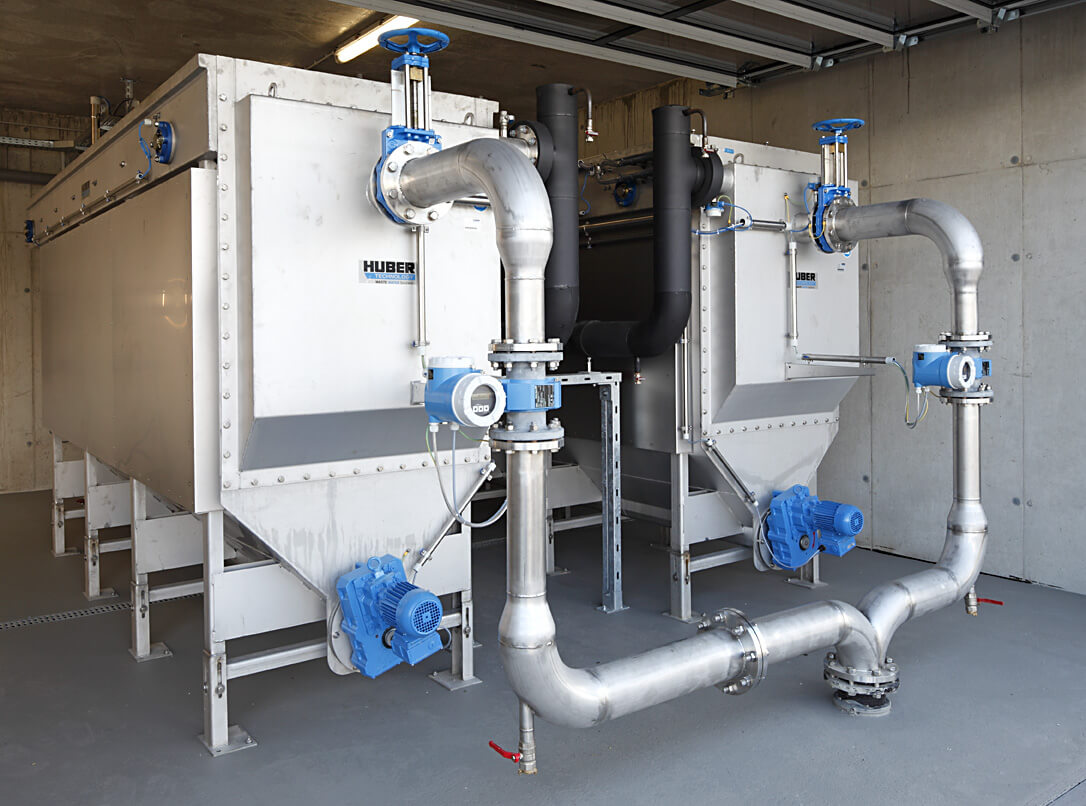
Two HUBER Heat Exchangers RoWin for heat recovery from process water.

The HUBER Heat Exchanger is available in different sizes.
Process Technology
HUBER solutions for wastewater heat recovery and wastewater temperature reduction
A particular challenge when using heat exchangers for industrial process water and/or wastewater is when the medium tends to form a film on the heat exchanger surfaces. The more there is built up, the more the heat transfer capacity and efficiency is reduced.
With the HUBER Heat Exchanger RoWin, HUBER has developed a self-cleaning heat exchanger that ensures permanently high and efficient energy transfer.
For the removal of coarse contaminants and larger solids from wastewater or process water, HUBER offers a comprehensive range of screens and screening systems.
Downloads
Customer Information and Documents
FAQ
Frequently Asked Questions
This requires a heat exchanger system that is suitable for wastewater, such as the HUBER Heat Exchanger RoWin. It is important that high solids loads, organic matter, sand, grit and other wastewater constituents are not critical for operation. Self-cleaning of the exchanger surfaces and thus maintaining heat transfer are essential.
With such systems, depending on the design, the wastewater temperature can be lowered and the heat made available for further utilisation. In the case of direct use, industrial process water, for example, can be preheated with the outflowing wastewater, thus saving primary energy.
Many industries have very warm wastewater due to their processes, which both causes problems in biological treatment (max. 38 °C permitted for the biological system) and may not be discharged into receiving waters or sewers if the temperatures in the effluent are too high.
With a suitable wastewater heat exchanger, this temperature can be effectively lowered and the extracted heat can either be made available for reuse or released via cooling systems.
This depends on the inlet temperatures and flow rates, on the available cooling water flow (quantity and temperature), as well as on the subsequent consumer of the heat. Each application must be considered individually and the right heat exchanger selected. By installing several heat exchanger systems operating in parallel, large amounts of heat can be extracted without any problems, provided that the appropriate cooling medium is available.
Heat extraction from process water or wastewater from the food industry, breweries, beverage industry, chemical industry, paper manufacturing, textile industry, commercial laundries, hospitals. Heating or cooling of building complexes, feeding recovered heat into heating networks, cooling of wastewater to comply with official effluent discharge requirements.
Basically, a certain temperature level is necessary. For industrial wastewater, temperatures of up to 85 °C can be used. To avoid excessive fouling of the heat exchanger, pre-screening of coarse solids (> 6 mm) is recommended.
Almost any type of water can be used for heat recovery if pre-screened properly. This includes, for example, water from surface waters, wastewater from industrial processes, grey water or already purified water from the operational sewage treatment plant outlet.