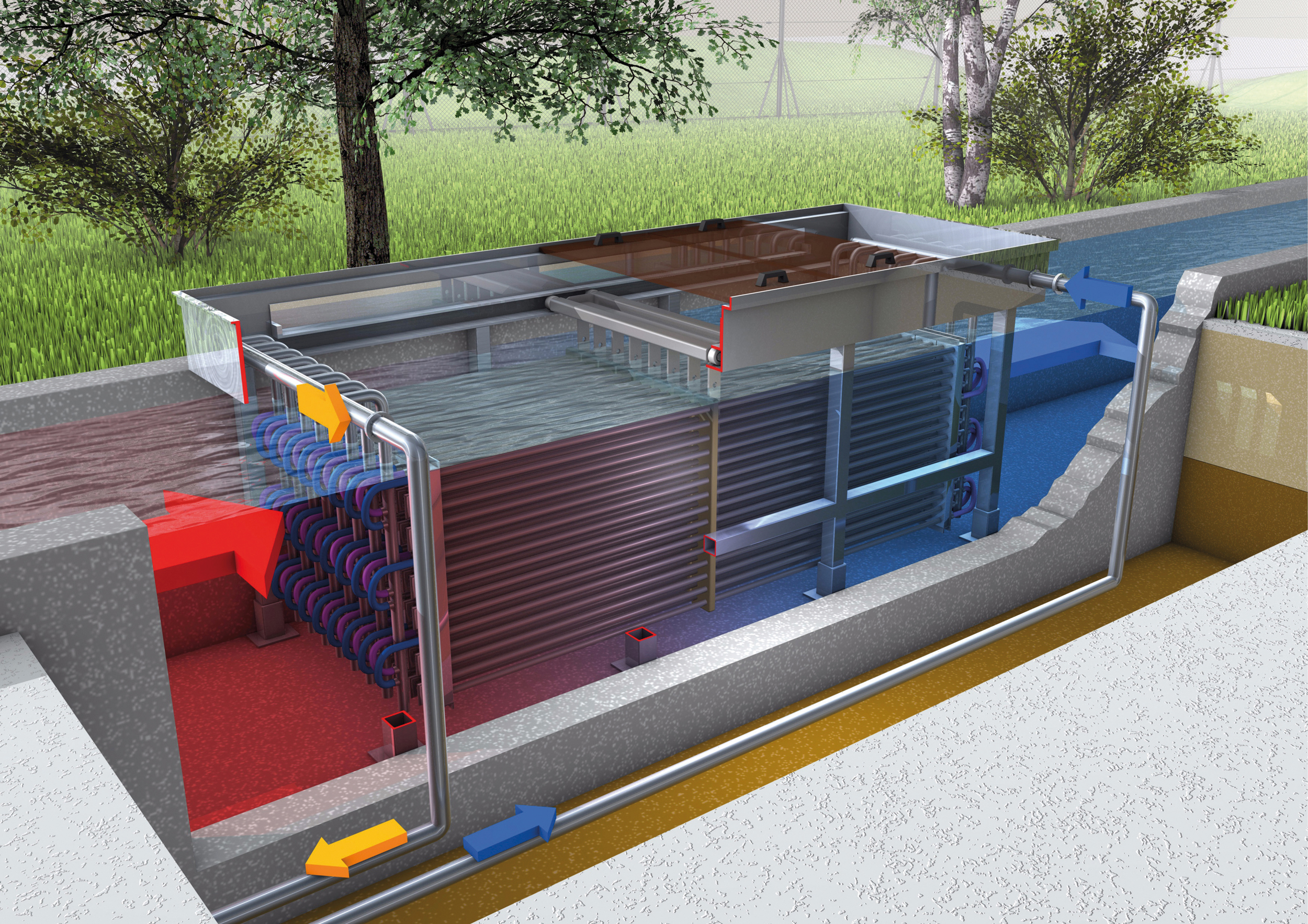
Basically, a certain temperature level is necessary. Municipal wastewater typically has temperatures of 10 - 25 °C, which allow ideal operation of a wastewater heat exchanger. To avoid excessive fouling of the heat exchanger, pre-screening of coarse solids (> 6 mm) is recommended.
Various options for wastewater heat utilisation
Basically, there are three places where wastewater use is possible.
In buildings
Here, the wastewater generated in the building is used directly for heat utilisation. The advantage of high wastewater temperatures is offset by disadvantages such as reduced water quantities, fluctuations in the time of day and high operating costs.
Wastewater from the sewer system
With the HUBER ThermWin process, wastewater flowing in the sewer system can be used as a heat source (heating) but also as a heat sink (cooling).
Sewage treatment plant effluent
Here, the treated effluent at the outlet of the sewage treatment plant is used as a heat source. This is where the largest amounts of water are available, and if there are consumers for the heat, the installation of a HUBER Heat Exchanger RoWin in the outlet of the sewage treatment plant is an option here.
FAQ
Frequently Asked Questions
Almost any type of water can be used for heat recovery if pre-screened properly. This includes, for example, water from surface waters, wastewater from industrial processes, grey water or black water in the municipal sector or already purified water from the sewage treatment plant outlet.
Heating or cooling of building complexes, feeding recovered heat into heating networks for example in industrial areas/parks, cooling of wastewater to comply with official effluent discharge requirements.