If the wastewater quantities are very small but the temperature is very high, the wastewater heat exchanger can be operated discontinuously (batch mode).
HUBER Heat Exchanger RoWin Modular design for use with all types of wastewater
Energy recovery from wastewater for heating and cooling
- Modular design
- Developed especially to be used with all types of wastewater
- Odour-tight
- Not easily affected by coarse and floating material
- Low maintenance requirements
- Self-cleaning
Right below the ground, in sewers, is a hidden and seldom used source of energy: our wastewater. Generally the temperature of sewage is in the range of 12 to 20 °C. Even during winter the wastewater temperature never drops below 10 °C, or only for a few days. This makes wastewater an excellent heat source for the operation of heat pumps.
As a link between the wastewater and heat pump, a heat exchanger is required to extract the heat energy contained within the wastewater: The HUBER Heat Exchanger RoWin transfers the thermal energy from the wastewater to the heat pump. Up to 80% of the useful heat can be recovered from the wastewater and utilized economically.
Utilisation of wastewater as a heat source is especially suitable to be applied in large buildings, such as nursing homes, hospitals, schools or swimming baths. It is also possible to recover heat from the effluent of sewage treatment plants and use it e.g. for sludge drying.

HUBER Heat Exchanger RoWin

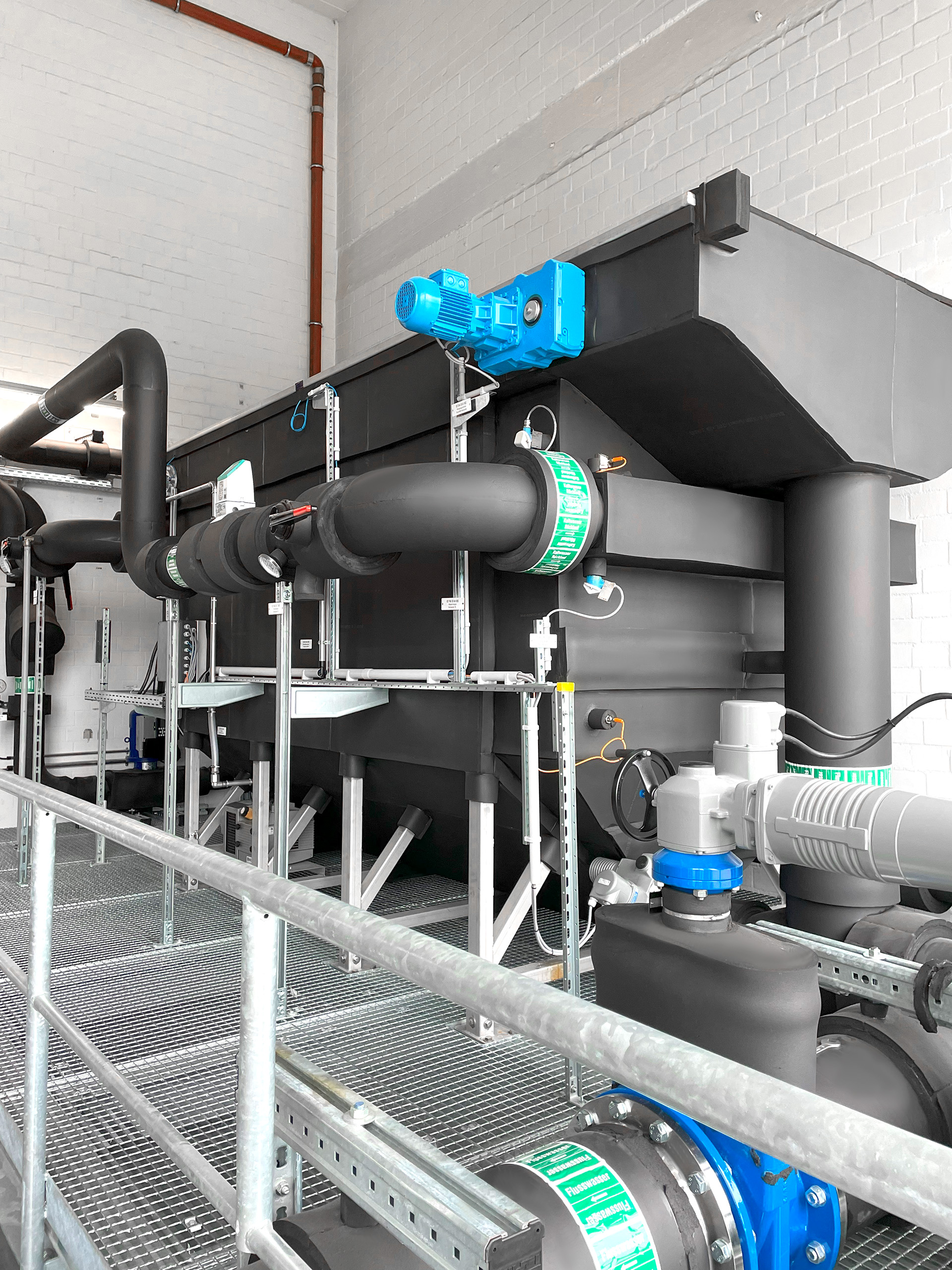
HUBER Wastewater Heat Exchanger RoWin installed in boiler room

Partially insulated version of the HUBER Wastewater Heat Exchanger RoWin

Above ground, parallel installation of two HUBER Wastewater Heat Exchangers RoWin

A HUBER Wastewater Heat Exchanger RoWin C is lifted into the concrete channel

Eco-friendly heat supply for buildings: HUBER ThermWin process with HUBER Heat Exchanger RoWin

Design and Function
The HUBER Heat Exchanger RoWin consists of a welded stainless steel construction in which horizontal pipe modules are arranged in parallel. The pipe modules are made of stainless steel to achieve maximum heat transfer efficiency. The pre-screened wastewater flows through the heat exchanger and, via the compactly arranged pipes, gives off its thermal energy to the cooling water. The energy for the heat pump is supplied through the heated cooling medium.
Due to the specific chemical-biological properties of wastewater a biofilm is developed over time on the heat transfer surfaces that significantly impairs heat transfer. Preventive cleaning of the heat transfer surfaces with an innovative, fully automatic cleaning mechanism therefore is applied to ensure the maximum heat transfer capacity is permanently maintained.
Sediments and solids settling on the tank floor are removed by a screw conveyor and returned to the sewer along with the cooled wastewater. Due to the enclosed tank design and return of solids thermal energy is the only emission from wastewater. The HUBER Heat Exchanger RoWin is available, as required, with an outer insulation for particularly exposed sites. Installed above ground, the system offers the benefits of easy maintenance and operation.
Due to its modular design the HUBER Heat Exchanger RoWin can be tailored to suit specific site requirements. In combination with a heat pump up to several hundred kilowatts of thermal output can be generated, depending on the unit size.
With the optimal combination of both systems municipalities or industrial enterprises can cover up to 80 % of the heat required from wastewater as energy source.
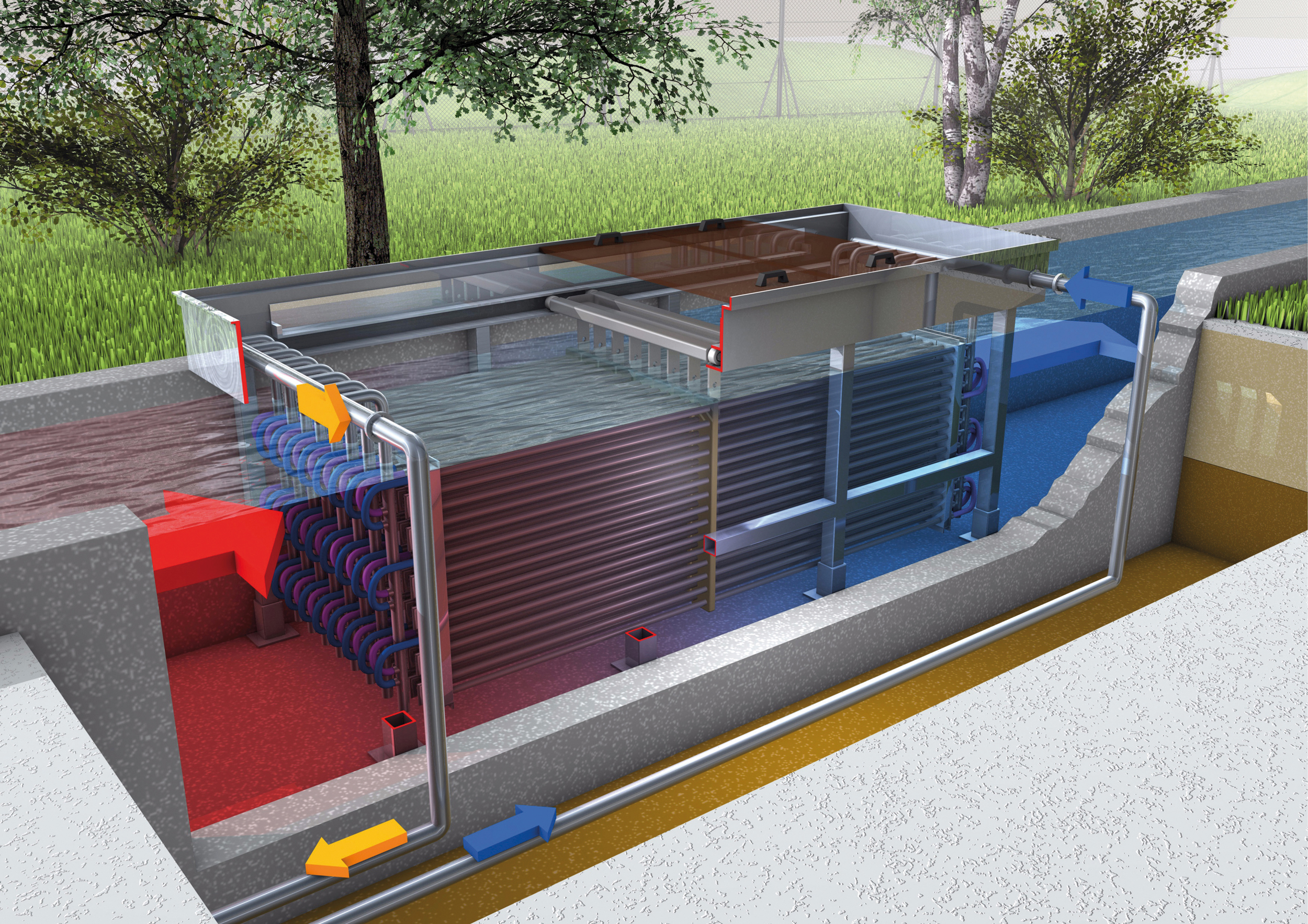
Version for Concrete Tank and Channel Installation: HUBER Heat Exchanger RoWin C
The HUBER Heat Exchanger RoWin C can be used for installation in the outlet of the wastewater treatment plant or in buffer tanks. Installed directly in the wastewater flow, the heat exchanger modules are optimally surrounded by the flow.
Due to the biological processes taking place, the temperature of effluents from sewage treatment plants is on average by 1 K higher than the inlet temperature. Furthermore, higher amounts of thermal energy can be extracted from WWTP effluents than with heat recovery plants installed in sewer systems.
The biological processes in the sewage treatment plant are not impaired and the introduction of the cool WWTP effluent outlet is beneficial for the flowing water biology. In addition, temperature and oxygen conditions in the waters are significantly improved.
If installed in the channel, no additional pumps are required as the wastewater flow normally runs off by gravity. This avoids costs and significantly improves the economic efficiency of such plants. Especially with regard to the energetic rehabilitation of wastewater treatment plants, the HUBER Heat Exchanger RoWin can make a decisive contribution.
Due to its compact design and installation in a channel or tank, no additional installation space is required and the available space utilised at an optimum. But biofilm growing on the heat exchanger surfaces cannot completely be ruled out with the use of the WWTP effluent. Integrated cleaning of the heat transfer surfaces therefore is of great importance to continuously maintain the maximum heat transfer capacity.
Several HUBER Heat Exchanger RoWin C units can be installed in parallel or in series for perfect adjustment to specific site conditions and customer requirements. Combined with load-bearing covers the units can also be installed under parking areas for example.
The Benefits of the HUBER Heat Exchanger RoWin and RoWin C
- Compact, enclosed tank design
- Continuous maximum heat transfer capacity
- Stable hydraulic conditions
- Fully automatic operation, minimum maintenance requirements
- Unsusceptible to grease, floating and coarse material
- Automatic removal of sediments
- Modular design for tailored solutions that meet the customer’s specific requirements
- Various possible applications in both the municipal and industrial field
Media
Videos and Animations
Downloads
Customer Information and Documents
FAQ
Frequently Asked Questions
When recovering heat from wastewater or sewage, heat pumps have a coefficient of performance between 4 and 6, i.e. for every 1 kWh of electricity they supply 4 to 6 kWh of heat. The higher the temperature of the wastewater and the lower the temperature of the heat supplied, i.e. the smaller the temperature difference to be overcome, the higher the coefficient of performance
The ratio of heat output to electricity used is between 4 and 6 (depending on the application).
Often, this value is also indicated as "SPF" (seasonal performance factor).
Heat extraction from process water or wastewater from the food industry, breweries, beverage industry, chemical industry, paper manufacturing, textile industry, commercial laundries, hospitals. Heating or cooling of building complexes, feeding recovered heat into heating networks, cooling of wastewater to comply with official effluent discharge requirements.
Heating or cooling of building complexes, feeding recovered heat into heating networks for example in industrial areas/parks, cooling of wastewater to comply with official effluent discharge requirements.
A wastewater heat exchanger is a heat exchanger that is suitable for operation with wastewater.
The wastewater heat exchanger must be designed in such a way that the solids contained in the wastewater do not cause any operating faults.
In addition, deposits (biofilm) form very quickly on the heat exchanger surfaces when operating with wastewater, so that regular cleaning of the heat exchanger surfaces is necessary, otherwise performance will be reduced. The HUBER Heat Exchanger RoWin is specially designed for operation with wastewater.
Basically, a certain temperature level is necessary. Municipal wastewater typically has temperatures of 10 - 25 °C, which allow ideal operation of a wastewater heat exchanger. To avoid excessive fouling of the heat exchanger, pre-screening of coarse solids (> 6 mm) is recommended.
Almost any type of water can be used for heat recovery if pre-screened properly. This includes, for example, water from surface waters, wastewater from industrial processes, grey water or black water in the municipal sector or already purified water from the sewage treatment plant outlet.


News