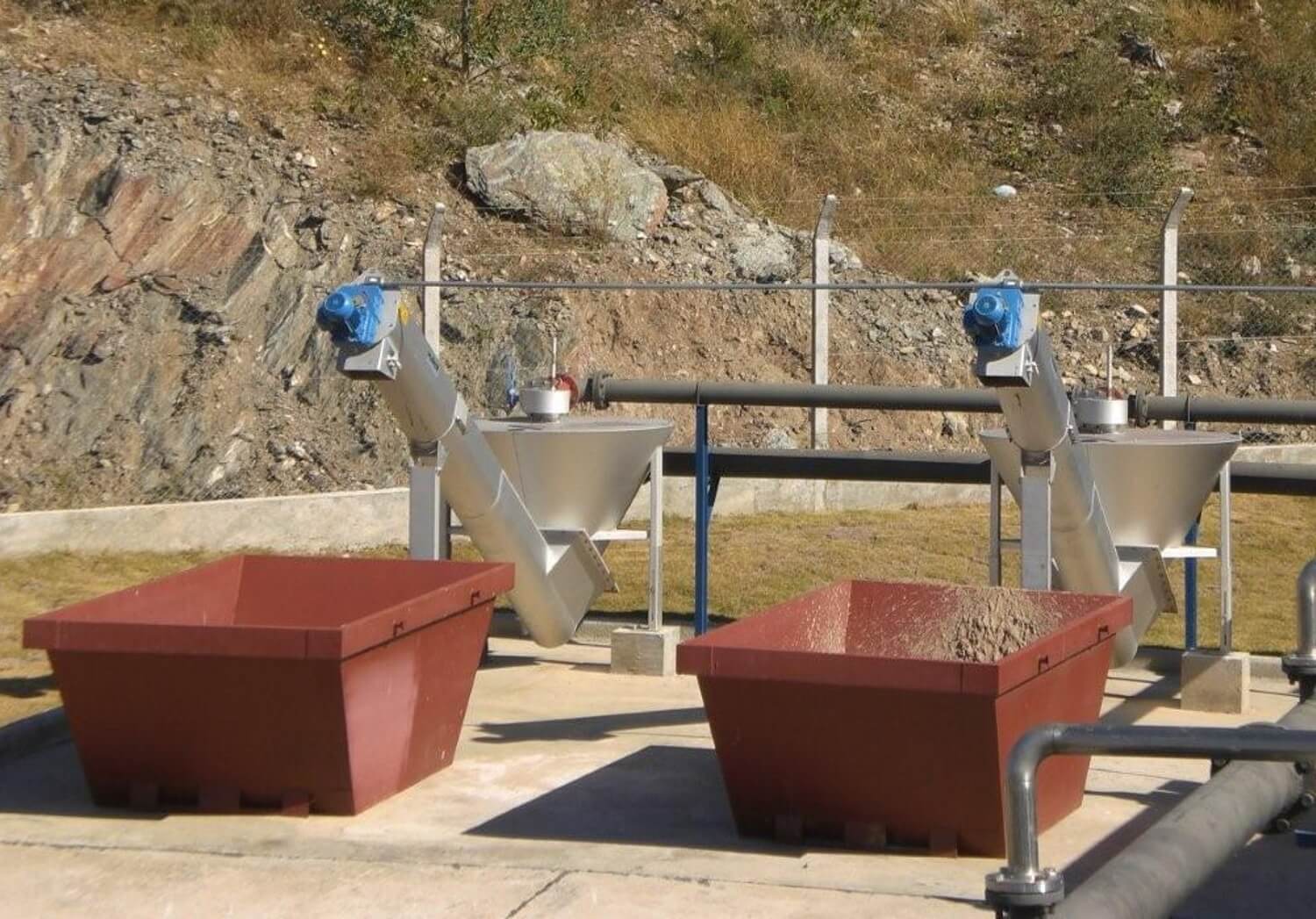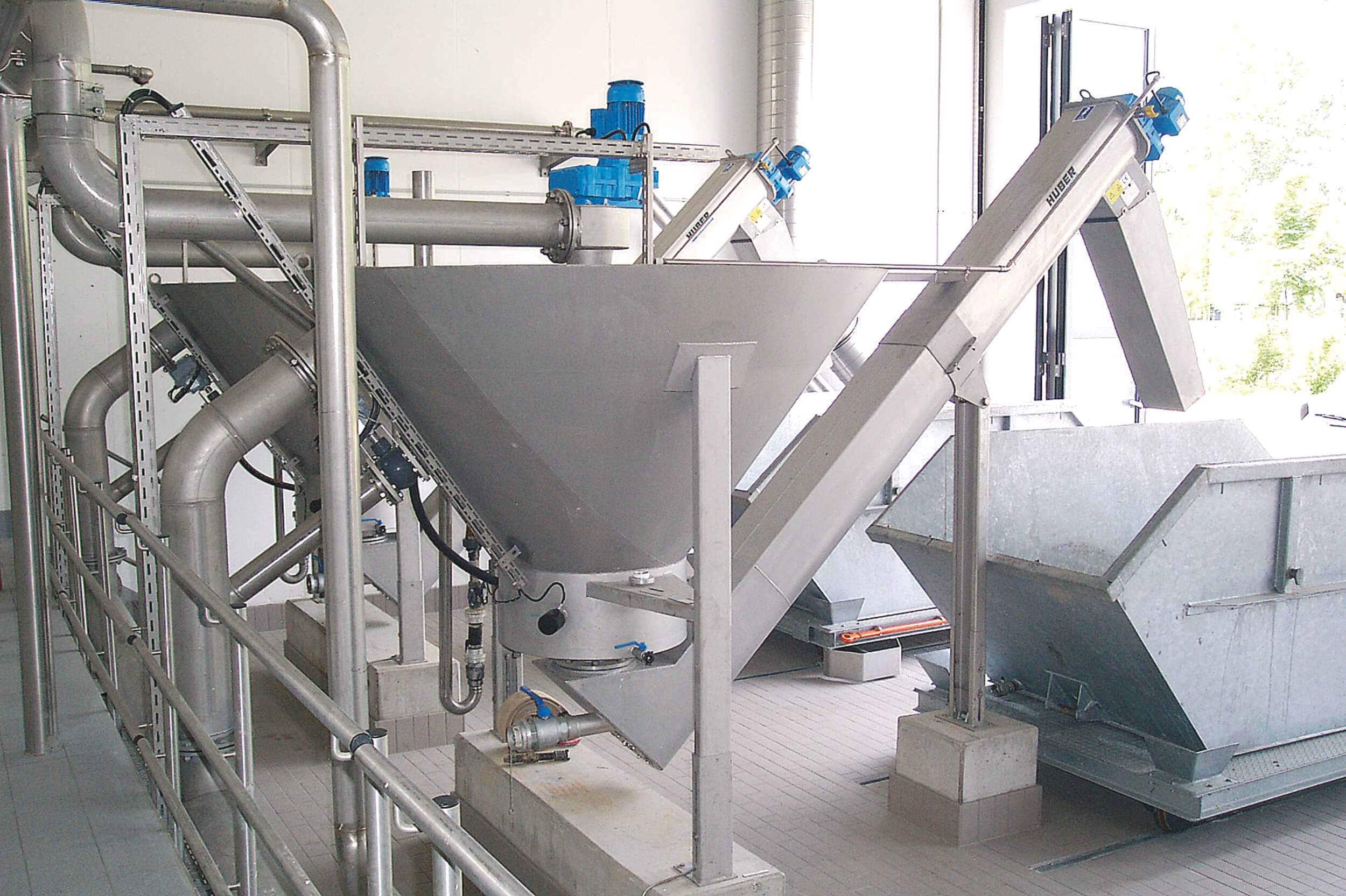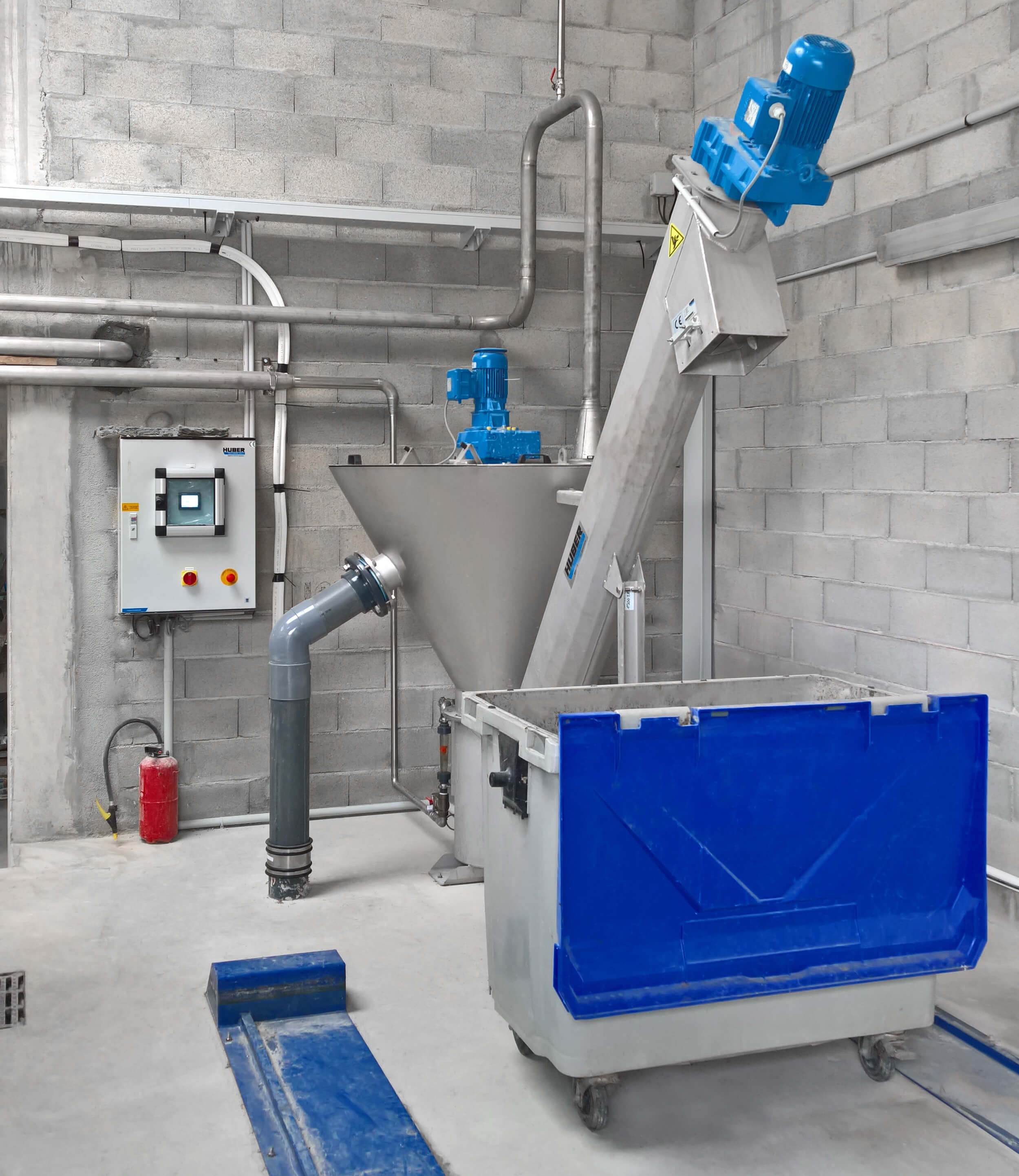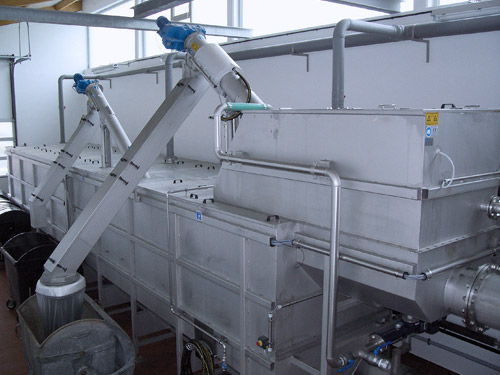
A good grit washing system is characterised by its ability to wash out the organic substances in the grit so that the loss on ignition in the washed grit is < 3%. In addition to the effective separation of organic and mineral components, the retention of fine sands is also decisive in practice, which is taken into account in the design of HUBER Grit Washing Plants.
HUBER Grit Washer RoSF4 T Treatment of partly dewatered grit from wastewater treatment plants
- Reduced disposal costs
- Less than 3 % organic content
- Very high solids content of > 90 %
- Easy to retrofit after existing grit classifiers
Conventional grit separation
Conventional grit classifiers separate virtually all solids contained in the grit trap effluent. This classified and partly dewatered grit is usually more or less contaminated with organic particles.
Subsequent grit washing
The classified grit is therefore further treated in the subsequent grit washer where the organics are separated from the mineral particles.

HUBER Grit Washer RoSF4 T

Classifying screw with subsequent HUBER Coanda Grit Washer RoSF4 T

The HUBER Grit Washer RoSF4 T washes the classified grit from a HUBER Circular Grit Trap HRSF

Design and Function
Due to a defined introduction of upwardly directed service water the grit situated in the lower part of the HUBER Grit Washer RoSF4 T will be fluidised in flow, i.e. a grit fluidised bed is generated. Within this fluidized bed the lighter organic particles are separated from the dense grit particles, independent of the particle size.
This process is supported by the central stirrer keeping the particles in motion. After removal of the organic material the clean grit is removed through a classifying screw, statically dewatered and discharged into a container.
The removed organics are automatically discharged with the introduced wash water.
The Benefits of the HUBER Grit Washer RoSF4 T
- Reduced disposal costs
- Dewatering of washed grit to approx. 90 % dry residue
- Organic content reduction to < 3% loss on ignition
- Throughput capacity up to 3.0 m³ solids per hour
- Low investment costs
- For easy installation subsequent to grit classifiers, complete plants, circular grit traps
- Grit removal screw supported on both ends for long life
- High corrosion protection
Downloads
Customer Information and Documents
FAQ
Frequently Asked Questions
In order to be landfilled, the grit must be further treated before. Depending on the size of the sewage treatment plant and the amount of grit, grit classifiers or grit washers are used. The state of the art is now the grit washer.
In municipal wastewater treatment, grit is separated in a grit trap. This separation takes place by sedimentation, i.e. the grit settles in the grit chamber after sufficient retention time. However, since there are not only mineral substances such as grit in the wastewater, but also many organic solids, these also settle to a greater or lesser extent. As a result, when the grit is discharged from the grit chamber, it sometimes contains a large amount of organic solids. This contamination of the grit with organic matter hinders, among other things, cost-effective landfilling or reuse of the grit.
Grit washing with a HUBER Grit Washer RoSF4 solves this problem and produces clean grit with an organic content of less than 3% loss on ignition, the HUBER Grit Washer RoSF G4E reduces the organic content to ≤ 5%.
Conventional grit classifiers separate virtually all solids contained in the grit trap effluent. This classified and partly dewatered grit is usually more or less contaminated with organic particles. With further treatment in a subsequent grit washer, the organics are separated from the mineral particles.